


It's Thursday night and you've got dinner booked in Guildford for 7.30pm, and a menu you've already looked at three times on your phone.
You've been "good" all week. Protein at breakfast, a walk at lunch, no wine on Tuesday. And now you're doing the maths: the bread basket, the bottle someone will definitely order, the dessert you'll be offered and pretend you don't want.
By Friday morning you'll either feel proud of yourself for ordering the salad, or guilty for ordering what you actually wanted. Neither feels great.
Here's the thing. Choosing healthy meals when eating out isn't about ordering the most boring thing on the menu. It's about a handful of simple choices that let you enjoy the meal, keep your energy steady and wake up the next day feeling like yourself. This is exactly how I help my clients across Surrey do it.
Why eating out feels so loaded with guilt
Most of the professionals I work with don't necessary have a food knowledge problem. They know a salmon fillet is a better choice than a deep-fried starter.
What they have is an all-or-nothing pattern. The week is either "on plan" or "ruined". One meal out tips it into ruined, so the rest of the weekend becomes a free-for-all, followed by Monday's fresh start.
That cycle is where the guilt comes from, and it can be all-consuming. Restricting all day before a meal out usually means arriving starving, eating far more than you planned, and then compensating the next day by skipping breakfast or punishing yourself at the gym. The food noise often gets louder, not quieter.
One of the biggest myths I bust with clients is you do not need to say no to every dinner out to get results. If your career involves entertaining, a plan that only works when you stay home is not a plan.
What one meal out actually does to your body
A single rich meal does not undo a week of steady eating. It can't. The body responds to patterns, not single events.
What one meal out can do is affect how you feel the next day:
A carb-heavy meal on an empty stomach can send blood sugar up quickly and down just as fast, which is often behind that heavy, foggy feeling the morning after.
Alcohol fragments your sleep, even when you fall asleep easily. That's why you can sleep eight hours after a dinner out and still wake up tired.
A very late, very large meal keeps your digestion working when your body wants to be recovering.
None of this is a reason to avoid eating out. It's a reason to make the meal work for you, not against you.
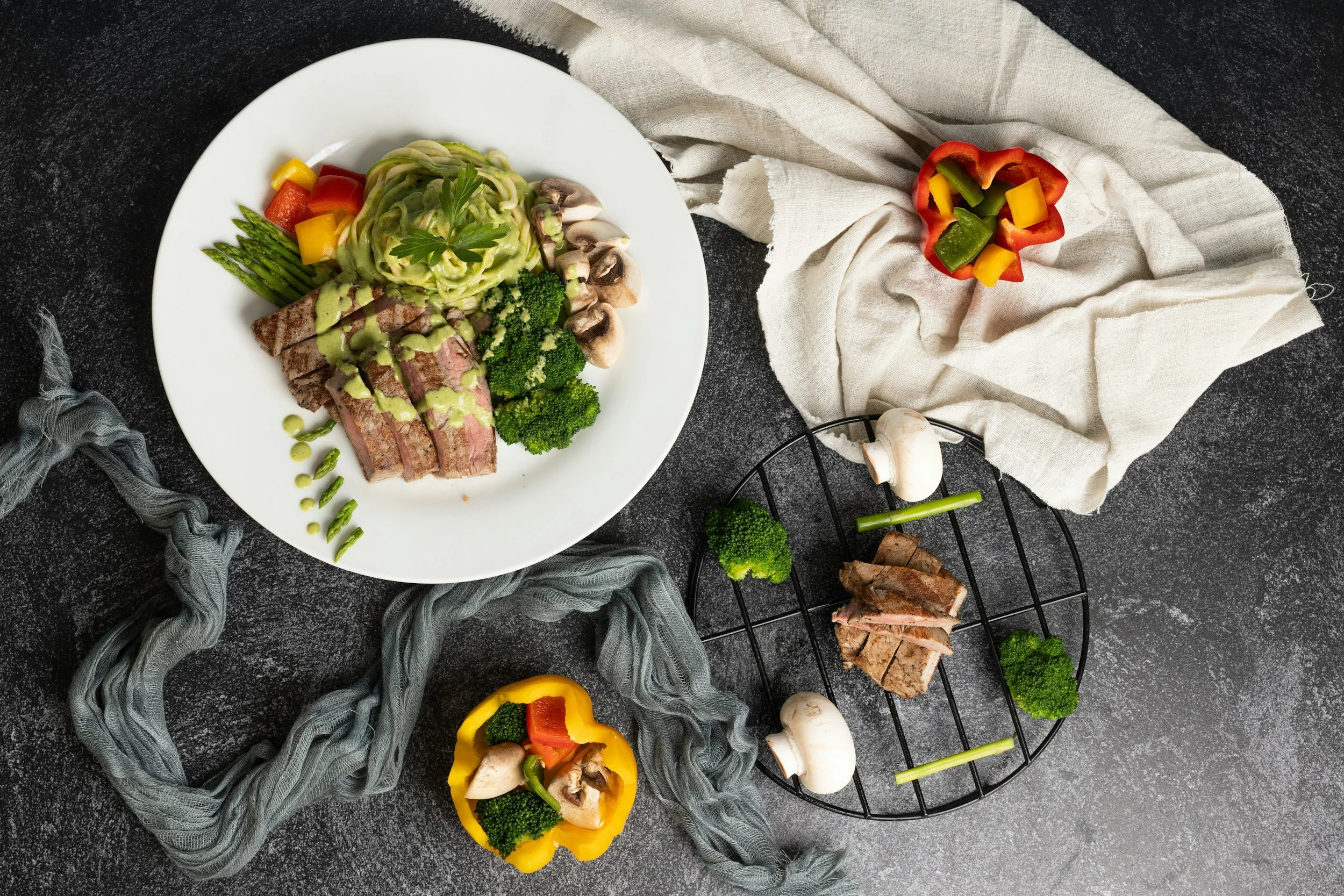
How to choose healthy meals when eating out: my 4-step plate
This is the simple framework I give every client. There’s no need to count calories if you aim for 80% full.
Find the protein first. Fish, chicken, steak, lamb, tofu, eggs or beans. Protein supports satiety for longer and slows down how quickly carbs are absorbed into the bloodstream.
Add colour. Ask for a side of greens, a salad or roasted vegetables. Fibre helps protein to keep blood sugar steady.
Choose your carb on purpose. Bread basket, chips, pasta OR dessert. Pick the one you really want and enjoy it, rather than having a bit of everything and not really enjoying any of it.
Watch the sauce, not the fat. A drizzle of olive oil or a knob of butter is fine. Cream sauces and lots of fried sides add up quickly, so treat them as the carb choice above.
There's also good research on eating order: starting with vegetables and protein before carbs appears to reduce the blood sugar rise after a meal. At a restaurant, that might mean eating your starter salad or prawns first and saving the potatoes until the end.
Italian
Go for a grilled fish or meat main with greens, or a tomato-based pasta rather than a creamy one. If you love the bread, have one piece and enjoy it properly.
My favourite: Clava, West Byfleet
Indian
Tandoori dishes, tikka and dal are your friends. Share the naan and the rice rather than having both to yourself, and add a vegetable side like saag or a salad.
My favourite: Raviz, Guildford
The Sunday pub roast
A roast is one of the easiest meals out to balance. Load up on the meat and vegetables, choose either potatoes or the Yorkshire pudding to really enjoy, and go easy on the gravy jug.
My favourite: The Queens Head, Weybridge
Steakhouse
A fillet steak with a green salad or seasonal vegetables is already a strong choice. Choose a soup or a vegetable starter if you’re having, or if you’ve opted for dessert, sharing means you can try without missing out.
My favourite: The Gosling, Woking
Japanese and Sushi
Sashimi, edamame, miso soup and grilled dishes are all protein-rich. Sushi rolls are mostly rice, so pair them with something protein-heavy rather than ordering a full platter of rolls.
My favourite: Kinjo, Cobham
Before you go: three things that make the meal easier
Most of the good decisions happen before you sit down.
Don't arrive starving. Have a proper lunch with protein, and if the dinner is late, a small snack around 5pm: Greek yoghurt, a handful of nuts or a boiled egg. Arriving ravenous is how the bread basket disappears.
Look at the menu earlier in the day. Decide what you'll order while you're calm, not when the table is waiting and the waiter is hovering.
Decide your drinks plan in advance. "Two glasses, then sparkling water" is far easier to stick to than deciding glass by glass.
If you want more on fuelling a busy Surrey week, my post on meal planning for busy professionals in Surrey covers the days around your meals out.
Alcohol at client dinners without the next-day fog
This is the one most of my clients worry about. Here's what works in real life:
Alternate every drink with a glass of water. You'll drink less without anyone noticing.
Choose your drink and stick to it. Mixing drinks makes it harder to keep track.
Eat before you drink. Alcohol on an empty stomach hits faster and lowers your resistance to everything else on the menu.
Have your last drink a few hours before bed if you can, to protect your sleep.
A sparkling water with lime looks exactly like a G&T if you'd rather not explain yourself.
If you often wake up foggy after a night out, my post on brain fog: symptoms, causes, and how to actually clear it explains why.

Don’t compensate the morning after
This is where most people undo the good work. The instinct after a big meal out is to skip breakfast, do an extra hard workout or "be really good" all day.
It backfires. Skipping breakfast after a late meal and a few drinks usually sends blood sugar and cortisol on a rollercoaster, and ends with lots of snacking. Pushing harder at the gym adds more stress to a body that's already recovering. I explain why in 5 mistakes that might be hindering your body composition.
Instead:
Eat a normal, protein-rich breakfast, like eggs on wholegrain toast or Greek yoghurt with berries and seeds.
Drink plenty of water before your first coffee.
Go for a walk rather than a punishing session.
Carry on as normal. No fresh start needed, because nothing went wrong.
“One of my clients used to dread eating out. Choosing from the menu felt overwhelming, and worrying about how she’d feel the next day spoiled what should have been a relaxing evening. Now she decides what to order before she arrives, and leaves feeling comfortable and satisfied.”
Eating out on Mounjaro or other weight loss injections
If you're using a GLP-1 medication like Mounjaro or Wegovy, eating out can feel different. Your appetite is smaller, and rich, fatty or very large meals can leave some people feeling sick.
A few things help:
Order a starter as your main, or share a main.
Eat your protein first so you get enough before you feel full.
Go gently with alcohol, as many people find they tolerate less.
Speak to your prescriber about any side effects.
I cover this in more detail in how nutrition can support clients using GLP-1 medications.
Healthy eating out: your questions answered
Is eating out bad for you? No. Eating out regularly can absolutely fit a healthy, balanced way of eating. What matters is the overall pattern of your week, not any single meal.
How can I eat healthy when eating out? Start with protein, add vegetables, choose one carb you really want, and go easy on creamy sauces. Don't arrive starving, and decide your drinks plan before you go.
Should I go low carb when eating out? You don't need to. Choosing a complex carbohydrate such as beans or wholegrains rather than avoiding them completely, is easier to stick to and keeps the meal enjoyable.
Bringing it home
Eating out guilt-free isn't about finding the perfect order. It's about dropping the all-or-nothing thinking, building your plate around protein and colour, and carrying on as normal the next morning.
If client dinners, travel and family meals keep pulling you off track, this is exactly what we work on inside The Realign Method. I work with professionals across Surrey, in Woking, Weybridge, Guildford, Cobham, West Byfleet, and online across the UK.
Book a free 30-minute clarity call and we'll look at how to make your real week work for you.
References
Shukla AP, Iliescu RG, Thomas CE, Aronne LJ. Food order has a significant impact on postprandial glucose and insulin levels. Diabetes Care. 2015;38(7):e98–e99. doi:10.2337/dc15-0429
Shukla AP, Dickison M, Coughlin N, et al. The impact of food order on postprandial glycaemic excursions in prediabetes. Diabetes, Obesity and Metabolism. 2019;21(2):377–381.
Ebrahim IO, Shapiro CM, Williams AJ, Fenwick PB. Alcohol and sleep I: effects on normal sleep. Alcoholism: Clinical and Experimental Research. 2013;37(4):539–549. doi:10.1111/acer.12006
Leidy HJ, Clifton PM, Astrup A, et al. The role of protein in weight loss and maintenance. American Journal of Clinical Nutrition. 2015;101(6):1320S–1329S.
Jakubowicz D, Wainstein J, Ahrén B, et al. Fasting until noon triggers increased postprandial hyperglycemia and impaired insulin response after lunch and dinner in individuals with type 2 diabetes: a randomized clinical trial. Diabetes Care. 2015;38(10):1820–1826. doi:10.2337/dc15-0761
Polivy J, Herman CP. Dieting and binging: a causal analysis. American Psychologist. 1985;40(2):193–201.
NHS. Tirzepatide (Mounjaro). nhs.uk/medicines/tirzepatide

Written by Alison Diss Nutrition.
Alison Diss is a BANT Registered Nutritional Therapist, Personal Trainer and founder of The Realign Method. She created The Realign Method after her own experience of burnout in a high-pressure career and has helped 100+ ambitious professionals achieve steady energy, a sharper mind and a stronger body. She's based in Surrey and works with clients UK-wide and online.